I read "Don't Stop the Carnival" after moving the Caribbean and starting a single-suite bed and breakfast. Had I read it before hand, maybe I would have hesitated. Maybe I would have dismissed his '60s tale of strange characters and the havoc they wreak as fiction. Drama, yes. Fiction? Not quite. Wouk's work, dated and inflated though it may be, is a primer for someone dreaming of starting a business in the Caribbean.
Worrying over rains and empty cisterns, goods shipments, and odd contractors is par for the course here. Retiring here is one thing. Retiring to run a business, something else entirely. I met a resident who made just that plan and now has more business than "you can shake a stick at." Good for the pocketbook, bad for afternoons planned on the beach blanket.
From what I understand Wouk lived on St Thomas at some point. I don't think he managed a hotel as his protagonist Norman Paperman flees New York City to do. I won't spoil it, but Norman's daydream doesn't quite turn out as he imagined. Quite a bit of work is involved. Work. The word doesn't disappear once one crosses the southerly latitudes. The scenery helps, though.
Tuesday, September 25, 2007


Monday, September 24, 2007
Seven Highlights of Scenic Old San Juan


Old San Juan is only seven blocks by seven blocks. In that small space; however, a wealth of museums, lovely architecture, delicious foods and scenic vistas abound. Here are 7 highlights of our Old San Juan walking tour.
Enjoy carillo, the local food fare. Some of our favorites: mallorcas, a wonderful ham and cheese on puffed bread sprinkled with powdered sugar and plantain tamales with pork wrapped in banana leaves. Yum!
Sip the delicious yet strong local coffee while people watching in one of the many shady parks known as plazas.
Dine on tapas at El Convento. The former convent and oldest hotel in Old San Juan's room rates may burst your budget, but tapas in the courtyard dining area are both tasty and reasonably priced.
Tour one of the many museums of local arts, culture and history. Our pick the museum of the family showcases family life of Old San Juan in the 1800s. Cost: free!
Shop for local and regional crafts. Yes, mass-manufactured goodies can be found in several tourist shops, but a seek out the stores offering unique finds such as wood carvings, jewelry and handicrafts.
The wide-open horizon of the Atlantic Ocean from El Morro is worth the hike on a hot, sunny September day. Refresh yourself with a Piragua, the Puerto Rican snowcone.
Or just browse the side streets and quiet courtyards behind the doors of Old San Juan. A beautiful and welcoming city.
Wednesday, September 19, 2007
Puerto Rico--a peek inside

About 40 minutes from St Croix as American Eagle flies lies the historic gateway to the Caribbean, Puerto Rico. While I've visited the San Juan International Airport many times whist awaiting connections to other destinations, I recently enjoyed a few days on the island herself. An experience definitely worth the wait and most probably another blog post.
Did you know Puerto Rico is the most popular Caribbean destination? The diverse island offers Atlantic and Caribbean beaches, a large rain forest, delicious food, beautiful architecture and the U.S. economy with a distinctly Latin flavor.
We visited in September: the height of the hurricane season and nadir for tourist season. Even so, a cruise ship docked in Puerto Rico during our stay. A behemoth from which camera-clad passengers in shorts trickled. I've never cruised before. I'm waiting for the pet-friendly cruises to begin. Did you know that only the QE2 offers a pet-friendly cruise?
The photo is a shot of one of the watch turrets of El Morro the massive, ancient Spanish fort that essentially surrounds Old San Juan, our home base. Did you know this particular blog was just a tease for more to come? I warned you at the beginning.
Tuesday, September 18, 2007
Small delights

A key ingredient to enjoying life here is reveling in the small delights. When you live on an island that is less than 30 miles long and about 7 miles wide, new opportunities are, well, confined. Unless one intends to fly or sail away regularly, inspiration must be found at home.
I am surprised, consistently by the slight details: the light patterns made by clouds passing over the mountains and the light affecting color of the sea out my window which changes day to day sometimes reflecting astounding shades of turquoise, gold and even pink.
I am both enthralled and vexed by the local flora. Beautiful flowers will blossom for a day then disappear. Tan tan trees will affix themselves to any surface, root and grow, despite all eradication efforts.
Often people travel to the Caribbean, to experience the undersea creatures. I find the terrestrial fauna just as fascinating. Take the little visitor in the photo. Lizards dart and dash about the flower beds, hang suspended from the exterior window screens and sometimes find themselves inside the house, where my cat Gus hunts them with skill. This little guy surprised me on the clothes line, resting atop a pillow sham, tinier than a clothes pin.
No, he's not the latest movie, or die-for restaurant, or must-have purse, but a bit of wonder nonetheless and inspiration enough for this post.
Come enjoy the small details at HaypennyRest.
Monday, September 17, 2007
Sour Times

This blog is dedicated to the over-productive key lime tree on my property. We juice them, flavor with them, I even clean with them and I'm barely able to keep up with the dozens of new fruits that appear each morning.
My goal is to squeeze about 50 each day this week and freeze the juice. Maybe then I'll catch up to the little key lime tree that could.
I read in A Short History of the West Indies by Parry, Sherlock and Maingot (purchased at the Whim bookstore on island) that the majority of the fruits thought of as tropical are not native to the Caribbean. According to the book, the only native plants of significant importance were cassava and tobacco. Coconuts and carambola fruits arrived from South Asia. The Spanish brought bananas, figs, the economic juggernaut sugar cane and all the citrus, including, I suppose, my key lime.
While it will not taste nearly the same for those enduring a frosty morning in the extreme northeast, enjoy a nod to sunshine with our favorite lime concoction.
4 key limes (the grocery green variety can sub)
1 cup sugar to taste (probably will need less for less pungent grocery limes)
water
Crush limes in a food chopper then transfer to a standard size blender
Add sugar
Add water to nearly full
Blend until smooth as possible
Strain into pitcher
Serve over ice with a shot of Cruzan Rum, if you like. After all the Cruzan Rum tag line is "so have a drink today."
Limes available while they last at HaypennyRest.
Sunday, September 16, 2007
the Current
St Croix spend Friday night in the dark. An island-wide power outage occurred sometime Friday afternoon. Power was restored at varying times depending on location. Ours clicked back on sometime around 9 p.m. (when we'd decided to go to bed) but a friend on the west end of the island said hers was not restored until 10 p.m.
Power outages arise intermittently on St Croix. The local reference is the "current" is out or gone or off. Our current is usually unaffected. We lived previously on the northwest side of the island and current outages happened more frequently than I liked. A long-time resident of the east end of the island said his current goes out once a week. Embellishment? Perhaps, but I tend to think that St Croix exemplifies most locations of natural beauty in that neatly-ordered conveniences take a back seat to nature. With beautiful views and beautiful weather, a few hours in the dark is a small price to pay. Besides the stars and fireflies provided us an evening of sparkling entertainment.
Come visit us at HaypennyRest, where, yes, we have a back up generator.
Power outages arise intermittently on St Croix. The local reference is the "current" is out or gone or off. Our current is usually unaffected. We lived previously on the northwest side of the island and current outages happened more frequently than I liked. A long-time resident of the east end of the island said his current goes out once a week. Embellishment? Perhaps, but I tend to think that St Croix exemplifies most locations of natural beauty in that neatly-ordered conveniences take a back seat to nature. With beautiful views and beautiful weather, a few hours in the dark is a small price to pay. Besides the stars and fireflies provided us an evening of sparkling entertainment.
Come visit us at HaypennyRest, where, yes, we have a back up generator.
Friday, September 14, 2007
the Fruit Man

The fruit man pays a scheduled visit to my husband’s workplace bringing fresh fruit for sale. I am uncertain of the frequency of his visits, but I believe he comes less often than the pate` man (who is actually an elderly woman) but more often than the fish man.
After weeks of missed opportunities, we finally struck a deal with the fruit man. For months papayas have flourished in our yard enjoyed only by the birds and one guest who found them delicious. I confess, I’m not crazy about papaya because they remind me too much of cantaloupe, the only fruit (until now) that I do not like. My husband falls into the cantaloupe category, too. I must further digress and share a cantaloupe story.
At a former workplace in
Back to the fruit man. We have sour orange, key lime, grapefruit, carambola (star fruit) and sugar apples. We hoped to trade any of these (we have an ample supply) for bananas. Nope, the fruit man only wants papayas. He has everything else. Of course when he makes his first visit, none of the papayas are ready. Only three can be found and one of those was maimed by birds during a three day visit to
These bananas were given to me by our house painter, CM Painting. He traded us for key limes and sour orange. These bananas are half the size of the average
Monday, September 10, 2007
Flew the Coop

Gone a week on a mini trip to Puerto Rico. The highlights will appear in an upcoming blog, I promise. I intend to publish with greater consistency and frequency whether anyone reads regularly or not.
Before departing for said trip, the following event occurred. A yellow breast, the Territorial bird of the Virgin Islands, flew into our sliding glass door and tumbled violently to the ground. I thought he was dead but discovered that, though bleeding, he survived. I created a nest out of a fruit container and began feeding him sugar water. At first he drank, eyes closed, intently but feebly imbibing every spoonful. After a few minutes, he regained not only consciousness but gumption and took off in our kitchen soaring up to perch on the rafters of our West Indian ceiling. At least a half hour or more later we managed to shoo him back out the door and into secure, shady branches of an umbrella tree. (I'm trying to post as a video, but haven't quite figured it out yet. . .)
Lesson learned, don't nurse a bird in the house.
Plan your own birdwatching excursion at HaypennyRest.com
Thursday, August 30, 2007
Low Season Blues

Check out Chuck, bone in tow, chillin’ at
I’m suffering from the low season blues. I assume that many other inn owners, restaurateurs, sailboat tour operators, etc are feeling the same. Beautiful beaches, sunny skies, calm turquoise waters and few paying customers around make for a seasonal affective disorder that saps one’s positive outlook and pocketbook.
Summer is the off season on
No Crowds
Want the beach mostly to yourself?
Low Season Discounts
Prices go down in the low season and visitors enjoy all the amenities, tours and excursions for a lot less. So come snap up a bargain; discounts last through November.
Same Great Sites
The beach, the mountains, and the fresh salt air, all the natural beauty that the
I guess I should add a fourth reason. Based on the Weather Channel,
Haypenny Rest is discounted from now through the end of November. Ask about the monthly flat rate.
Monday, August 27, 2007
Discover the top five reasons you should be in the US Virgin Islands—America’s Paradise.
- No Passport Needed
Come to the
- Direct Flights from the Mainland
American Airlines and Delta offer direct flights to St. Croix from
Travel between islands is convenient.
- US Economy
Stay on the
- Diversity
- Cultural Experience
The rich history of the islands gives travelers a glimpse into a fascinating past: exploration, piracy, colonial rule and eventual
Come visit us at HaypennyRest.
Friday, August 24, 2007
Goodwill Gecko

Slithering up walls, resting on verandas, lounging poolside, brightly colored gecko sculptures reside on home and hoteliers throughout
My husband and I snapped a shot of this little guy exposed when we removed our hurricane shutters. Seems we were not the only ones using them as shelter from the storm. Note the chunky toes, sure sign of a gecko.
The gecko sculptures found throughout retail stores in
Thursday, August 23, 2007
Post Dean exhale (a few days late)

Dean brushed past us, thank goodness, bringing some rain, stronger than average winds and high surf. Considering the Caribbean tide heights vary so little that high and low tide reports do not exist here, Dean certainly affected the ocean landscape. Typically tranquil Fredericksted harbor (pictured in typical state) lurched and rolled and swelled over the sea wall and splashed on to the Strand Street park walking path.
The very next day; however, gorgeous, sunny serenity returned. Undisturbed by Dean, St Croix is ready and waiting for visitors.
Wednesday, August 15, 2007
Calm before the Storm

My apologies for the break in communication, but recent trips to the states and a house guest put the blog on the back burner. Tropical Storm Dean, predicted to become Hurricane Dean, prompts a long over due post.
I plot Dean’s progression towards the
Monday, July 09, 2007
Mango Melee
Large rose colored orbs hanging from long skinny stems like spiders at the end of a web, if the web was a large dark green leafy tree, began to appear across the island. Mango season has arrived.
Mango trees can grow as large as a live oak tree and many are heavy with abundant mango fruits. Sidewalk stands of mangoes emerge not only along the side of the road but in driveways manned by children, the local equivalent of a lemonade stand.
Each year the
For someone who only found one variety of mango in her local Winn Dixie, I gained quite an education on the vastness of mangoes. I also bought some mango soap and a mango jam put up in a baby food jar and sold by an elderly woman sporting an American flag patterned bandanna around her head and matching petticoat. I have yet to try it, but I am convinced that it will be goo-ood.
Monday, July 02, 2007
Ha'Penny Bay

On the quiet south shore,
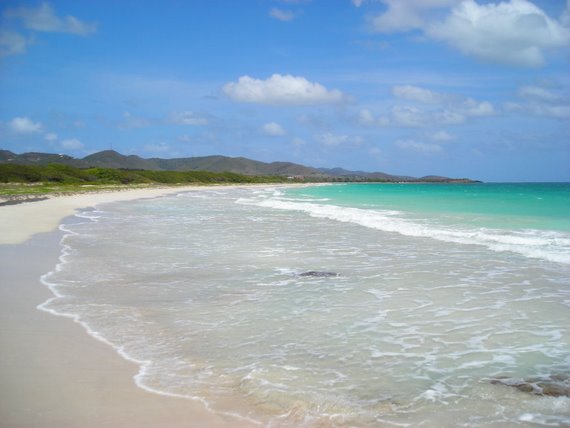
Weekdays the beach lies quietly awaiting the weekend’s excitement. Saturdays and Sunday afternoons local families gather to picnic, swim and sun. Walk west away from the splashing children gathered in the sandy bottomed cove nearest to the makeshift car park and Haypenny Bay extends as about a mile of quiet windswept path.
My favorite spot lies midway down the beach near a promontory that serves as my walker’s half way mark. At this outcrop, a few hundred yards toward the horizon lies a ring of reefs. Rather than the typically horizontal roll, waves crash over these undersea barriers at odd angles. The waters careen, stop short, and thrust upwards in brief waterspouts and sideways in great splatters. I imagine a great school of fish diving and rising and chasing each other’s tails.
Last week in a hurried pace, busy with checklists and errands, I trudged down the beach my dog in tow for his obligatory exercising. When I reach the reefs, out of habit, I paused to study them and felt my spirits rise. It seems we’re trying to be diligent, be dutiful, be successful, be on top and ahead of the game. . .Why is it so difficult to just be?
Saturday, June 16, 2007
Water, Water, Everywhere--the Cistern

“Water, water, everywhere and not a drop to drink. . .” The lament of Coleridge’s Mariner is shared by Crucians.
Friday, June 08, 2007
Mosquitoes in the Closet
I am from South Georgia , below the gnat line, so I know about bugs. In addition to the non biting but excessively worrisome gnat, I have first hand experience with fire ants, ticks, yellow jackets, love bugs, palmetto bugs, chiggers and ear-buzzing baddie, the mosquito. The tropical climate in St. Croix means no winter and year-round mosquitoes.
The local paper, the Avis, publishes health warnings about the mosquito-born aliment dengue fever. I’ve notice flyers in local businesses announcing dengue fever prevention methods and highlighting symptoms of infection.
I knew about malaria, but I never hear of dengue fever. My fears of dengue fever prompted my husband to serenade me (over and over again) with his original composition “Dengue Fever” sung to the tune of the theme song of that Spike Lee movie Jungle Fever.
“mama got dengue fever, papa got dengue fever,”
In addition to feasting on any portion of exposed skin, a band of mosquitoes had, until recently, taken up residence in our closet. Why the closet, I can’t say. There’s no standing water in the closet and we (the mosquitos’ main food source) don’t spend ample time in the closet. Maybe they chose to congregate in the dark amongst our clothes and plot attacking us in our bed whilst sleeping? Who knows the deep murmuring minds of mosquitoes?
“Chuck got dengue fever, Gus got dengue fever. . .”
Our early combative efforts against the closet dwellers consisted of guerrilla style fumigations: fling open the closet door, spray the swarm, jump back and quickly slam the door. One day while house cleaning, I took them on full force. I closed myself and my wind-tunnel vacuum with hose attachment in the closet and attempted to suck them to their deaths. I felt somewhat Jediesque as I swung my suction-powered saber at the X-wings dive bombing me. After about fifteen sweat-filled minutes, I ceased. I found a number of the dusty storm troopers’ corpses in the filter compartment.
“he got dengue fever, she got dengue fever, everybody got dengue fever. . .”
Friday, June 01, 2007
Hooray for Dial Up


Dial up. Ah yes, in the continuation of my previous blog about the taken-for-granted conveniences, high-speed Internet access is not a given. Absent from the
This curious position reminds me of a television commercial of my youth produced by the local celebrity Red Holland. Red hosted and starred in a show for outdoor sport enthusiasts aptly titled “Outdoors with Red” that aired every weekend and daily in the wee hours of the morning on WTVY, the ‘voice of the wiregrass.’ Typically, Red shot his own sponsorship commercials, too. In hawking satellite systems (a brand new product at the time), Red held an oversized galvanized washtub above his head and yelled, “Come on in, satellite!” pivoted 90 degrees and yelled “Come on in satellite!”
Since Dish equipment costs outweigh the enjoyment I receive from viewing and surfing and I learned at a tender age that washtubs on the roof are not a sound source of television reception (much less high-speed Internet), I went with plan B (line-of-sight wireless), then C (antenna on the roof wireless), then D (DSL) which was only partially successful resulting in Dial Up. Our house is located in a canyon and until upgrades on local towers are implemented, no reception is available. The DSL available in our area proved so popular that no more space exists on the modem. Pending modem upgrades, subscribers are offered dial up. Of course there are hot spots on island. I have checked email adjacent to the Carambola Golf Course, outside Paint N Things in the
I wish to goodness that Red Holland had a website to link to, but all my searching has come up with nothing except some Alabama transplant in New Jersey inquiring about where to find copies of the show and waxing nostalgic about "the chicken song" and a Florida sport fishing poll that had Red's show rated as #8 in a list about 30 of viewers' favorite shows. I think everybody in the panhandle voted. Here's a link to his former station WTVY.
Thursday, May 31, 2007
Limin'--Life without A/C
Dream of moving to the
Used to the climate controlled ice box—you may have difficulty adjusting. Very few locations have central air conditioning. I have witnessed this luxury only in large commercial buildings. Many residents operate window unit AC; however, be prepared for to pay for this convenience. The rental we lived in when we first moved on island was just about 1000 square feet, one window unit and four ceiling fans. Our monthly electricity bill averaged $220.
To off set the expensive electrical rates islanders use propane wherever possible. Our stove, clothes dryer (an appliance I rarely use because the clothes line works well) and hot water heater are propane based. Gas is delivered in large tanks, about 4 feet high, and stored outside one’s home. One visitor remarked that this method is akin to having a bomb outside your door. Would the underground gas line then be like having a bomb under one’s house? Out of sight, out of mind, maybe?
Tuesday, May 29, 2007
Settling in Paradise--five house hunting snags
Relocating to
Mortgage Rates
Be prepared for mortgage rates up to 1 point higher than stateside. The probability of damage due to natural disasters and high default rates on loans yield the increase mortgage rates. Compute this rate hike in your budget while house shopping. The high interest rates may put a once affordable asking price out of reach.
Property Insurance
In comparison with the states, property insurance can be astronomical. In addition, it is doubtful that you will be able to continue coverage with your local stateside insurance provider. On
Amenities such as hurricane shutters and home construction material affect rates. A wooden structure would result in a huge insurance bill. Most houses on
Flood insurance is required based on land surveys. Not only low-lying properties are affected—a house located on a mountainside could potentially require flood insurance due to storm run off.
Building Costs
At present (mid 2007) the building costs on
Homeowners Associations and Road Maintenance
Many neighborhoods operate under the agreements of a homeowners association. Similar to stateside groups,
Closing Dates
A 60 day closing time frame is typical. So get ready to wait a few days to move in to your new dream home.
Search the multiple listings service (MLS) with St. Croix-based realty agency (operating since 1930) Farchette & Hanley.
Subscribe to:
Posts (Atom)