Monday, July 09, 2007

Mango Melee

Large rose colored orbs hanging from long skinny stems like spiders at the end of a web, if the web was a large dark green leafy tree, began to appear across the island. Mango season has arrived.

Mango trees can grow as large as a live oak tree and many are heavy with abundant mango fruits. Sidewalk stands of mangoes emerge not only along the side of the road but in driveways manned by children, the local equivalent of a lemonade stand.

Each year the St. George Village Botanical Gardens hosts the Mango Melee to celebrate the harvest. In addition to crafts and food booths, typical of any festival, the Mango Melee features a display of the unbelievable amount of mango varieties. Besides the named species, I would estimate that at least a dozen unnamed local mangoes were on display. They range in size from larger than a softball to the width of a cell phone and all number of hues, textures and sweetness.

For someone who only found one variety of mango in her local Winn Dixie, I gained quite an education on the vastness of mangoes. I also bought some mango soap and a mango jam put up in a baby food jar and sold by an elderly woman sporting an American flag patterned bandanna around her head and matching petticoat. I have yet to try it, but I am convinced that it will be goo-ood.

Monday, July 02, 2007

Ha'Penny Bay


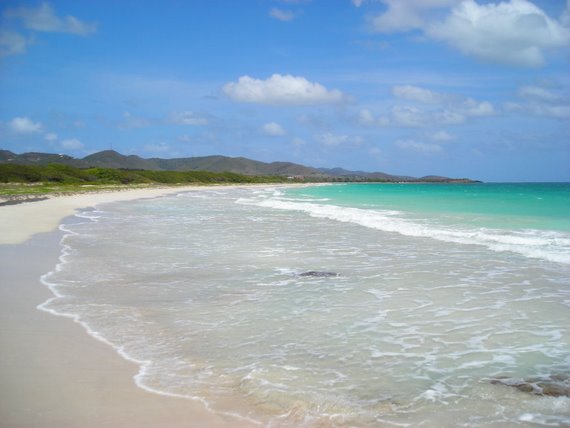
On the quiet south shore, Haypenny Bay is the stretch of beach closest to my house and visible from our residence. No commercial dwellings exist on the public westward side of the bay and only one residence is visible through the tall sea grape trees.
Weekdays the beach lies quietly awaiting the weekend’s excitement. Saturdays and Sunday afternoons local families gather to picnic, swim and sun. Walk west away from the splashing children gathered in the sandy bottomed cove nearest to the makeshift car park and Haypenny Bay extends as about a mile of quiet windswept path.

My favorite spot lies midway down the beach near a promontory that serves as my walker’s half way mark. At this outcrop, a few hundred yards toward the horizon lies a ring of reefs. Rather than the typically horizontal roll, waves crash over these undersea barriers at odd angles. The waters careen, stop short, and thrust upwards in brief waterspouts and sideways in great splatters. I imagine a great school of fish diving and rising and chasing each other’s tails.

Last week in a hurried pace, busy with checklists and errands, I trudged down the beach my dog in tow for his obligatory exercising. When I reach the reefs, out of habit, I paused to study them and felt my spirits rise. It seems we’re trying to be diligent, be dutiful, be successful, be on top and ahead of the game. . .Why is it so difficult to just be?

Saturday, June 16, 2007

Water, Water, Everywhere--the Cistern


“Water, water, everywhere and not a drop to drink. . .” The lament of Coleridge’s Mariner is shared by Crucians. St. Croix lacks fresh water resources save rainwater. Most residents in St. Croix have cisterns to meet water use needs.

A cistern is an underground tank for storing water. Unless one lives in Christiansted or Fredericksted, where city water is available, a cistern serves as the only means of obtaining water for the home.

In the Virgin Islands water conservation has been elevated to an art form. Gutters catch rainfall and divert this fresh water into the cistern for storage.

Typically located under the house in what would be a basement, stateside lies the cistern. Our cistern is a double tank. One tank for usage and one tank for overflow. If a cistern runs dry, which ours did shortly after moving in, one can order water from a water trucking company. A water delivery of 3600 gallons arrived in something akin to a fuel truck. This amount filled up one tank probably three-quarters.

Grey-water systems utilize recycled water from showers, sinks and laundry to water plants and yard. Diverted sewage flows into a septic system—usually the spot in one’s lawn that is the most verdant.

A local plumber told me that septic systems are a foreign concept among the Continentals he has met (i.e. stateside Americans). He said one client even told him that “we don’t have septic systems in the states.”

Gentle reader---everyone has a septic system of some form or fashion. Sewage has to go somewhere. It does not magically disappear when you flush. The city systems route sewage to a government maintained system. I grew up in a rural area which necessitated a septic system: living proof that septic systems do occur (and widely depending where one lives) in the states.

During hurricane season, one covers the cistern in take to prevent contamination by salt water. After the storm and until the “current” (electric power as the locals say) returns one accesses the cistern water from the interior hatch. Our hatch is in our living room. A native Islander called the post-storm bucket and rope method of getting to water, “camping in the cement cabin.”

I am more appreciated of rain than I have ever been. All my household water depends on rain. A late night storm is the most pleasant and comforting sound.

Better than weather reports, rain frogs announce the coming rain with a cacophony of frog cheers. Probably three times the size of any rain frog I witnessed growing up, the local variety, like my little friend in the photo, sport bulbous toes and sticky skins. Nocturnal by nature, their eyes of burnt sienna glisten in the darkness.

The frog in the photo napped in our birdbath for two days until the rains stopped, the sun appeared, and, overheated, he departed for shadier pastures or ponds as the case may be.

Friday, June 08, 2007

Mosquitoes in the Closet

I am from South Georgia, below the gnat line, so I know about bugs. In addition to the non biting but excessively worrisome gnat, I have first hand experience with fire ants, ticks, yellow jackets, love bugs, palmetto bugs, chiggers and ear-buzzing baddie, the mosquito. The tropical climate in St. Croix means no winter and year-round mosquitoes.

The local paper, the Avis, publishes health warnings about the mosquito-born aliment dengue fever. I’ve notice flyers in local businesses announcing dengue fever prevention methods and highlighting symptoms of infection.

I knew about malaria, but I never hear of dengue fever. My fears of dengue fever prompted my husband to serenade me (over and over again) with his original composition “Dengue Fever” sung to the tune of the theme song of that Spike Lee movie Jungle Fever.

“mama got dengue fever, papa got dengue fever,”

In addition to feasting on any portion of exposed skin, a band of mosquitoes had, until recently, taken up residence in our closet. Why the closet, I can’t say. There’s no standing water in the closet and we (the mosquitos’ main food source) don’t spend ample time in the closet. Maybe they chose to congregate in the dark amongst our clothes and plot attacking us in our bed whilst sleeping? Who knows the deep murmuring minds of mosquitoes?

“Chuck got dengue fever, Gus got dengue fever. . .”


Our early combative efforts against the closet dwellers consisted of guerrilla style fumigations: fling open the closet door, spray the swarm, jump back and quickly slam the door. One day while house cleaning, I took them on full force. I closed myself and my wind-tunnel vacuum with hose attachment in the closet and attempted to suck them to their deaths. I felt somewhat Jediesque as I swung my suction-powered saber at the X-wings dive bombing me. After about fifteen sweat-filled minutes, I ceased. I found a number of the dusty storm troopers’ corpses in the filter compartment.

“he got dengue fever, she got dengue fever, everybody got dengue fever. . .”

Friday, June 01, 2007

Hooray for Dial Up


Dial up. Ah yes, in the continuation of my previous blog about the taken-for-granted conveniences, high-speed Internet access is not a given. Absent from the St. Croix market are corporate big boys, such as Verizon and Comcast. Satellite television and Internet access through Dish; for example, is available at a cost, a much higher cost than stateside. Dishes are purchased out-right by the subscriber at a cost of $400-$600. A satellite service representative on island advised me that because of satellite positioning, two dishes would be required to access all channels. Seems St. Croix is betwixt ping points.

This curious position reminds me of a television commercial of my youth produced by the local celebrity Red Holland. Red hosted and starred in a show for outdoor sport enthusiasts aptly titled “Outdoors with Red” that aired every weekend and daily in the wee hours of the morning on WTVY, the ‘voice of the wiregrass.’ Typically, Red shot his own sponsorship commercials, too. In hawking satellite systems (a brand new product at the time), Red held an oversized galvanized washtub above his head and yelled, “Come on in, satellite!” pivoted 90 degrees and yelled “Come on in satellite!”

Since Dish equipment costs outweigh the enjoyment I receive from viewing and surfing and I learned at a tender age that washtubs on the roof are not a sound source of television reception (much less high-speed Internet), I went with plan B (line-of-sight wireless), then C (antenna on the roof wireless), then D (DSL) which was only partially successful resulting in Dial Up. Our house is located in a canyon and until upgrades on local towers are implemented, no reception is available. The DSL available in our area proved so popular that no more space exists on the modem. Pending modem upgrades, subscribers are offered dial up. Of course there are hot spots on island. I have checked email adjacent to the Carambola Golf Course, outside Paint N Things in the Gallows Bay Shopping Center and while waiting at the airport. After a month of exercising my Internet options and coming up with only one option, I’m relieved to check email in the privacy of my own home rather than the paint store parking lot. Dial up is really not that bad, not a slow as you may remember. My colleagues, Chuck and Gus, prefer it as well.

I wish to goodness that Red Holland had a website to link to, but all my searching has come up with nothing except some Alabama transplant in New Jersey inquiring about where to find copies of the show and waxing nostalgic about "the chicken song" and a Florida sport fishing poll that had Red's show rated as #8 in a list about 30 of viewers' favorite shows. I think everybody in the panhandle voted. Here's a link to his former station WTVY.

Thursday, May 31, 2007

Limin'--Life without A/C

Dream of moving to the Caribbean? Spending your days caressed by trade winds, relaxed, soaking up the genial sun . . .Limin’, to use the local phrase. If so, know that when you leave your stress-filled stateside lives you also leave behind a few other aspects of your daily routine, such as: central air conditioning, low electricity rates, curb-side trash pick up, underground gas lines, guaranteed access to high-speed Internet, low-cost dish-based television service, and in most cases city water/sewer and home mail delivery.

Air Conditioning

Used to the climate controlled ice box—you may have difficulty adjusting. Very few locations have central air conditioning. I have witnessed this luxury only in large commercial buildings. Many residents operate window unit AC; however, be prepared for to pay for this convenience. The rental we lived in when we first moved on island was just about 1000 square feet, one window unit and four ceiling fans. Our monthly electricity bill averaged $220.

Too many visitors from the states (continentals) depend on A/C so that local hotels often charge an additional 10 percent energy surtax.

I plan to operate our bed and breakfast sans A/C. Ceiling fans and stationary fans, yes, but no window units. We do not have this convenience in the main house and I hope to compete in local hotel market by being 10 percent cheaper than the next guy. I also hope to entice the kind of guests that want to live like the locals.

Propane

To off set the expensive electrical rates islanders use propane wherever possible. Our stove, clothes dryer (an appliance I rarely use because the clothes line works well) and hot water heater are propane based. Gas is delivered in large tanks, about 4 feet high, and stored outside one’s home. One visitor remarked that this method is akin to having a bomb outside your door. Would the underground gas line then be like having a bomb under one’s house? Out of sight, out of mind, maybe?

Check upcoming entries on the shedding of other stateside conveniences, sharing bathwater with the frogs and a trip to the dump all coming soon.

Island life is different. A new resident’s attitude in accepting these differences determines whether a move to the USVI is paradise or paradise lost. Don’t blame the Islands for not being like the States, blame yourself for an inability to adapt. Limin' is a trade-off.

Tuesday, May 29, 2007

Settling in Paradise--five house hunting snags

Relocating to America’s Paradise? Since St. Croix is a US Territory buying or building should be just like the states, right? Not quite.


Mortgage Rates

Be prepared for mortgage rates up to 1 point higher than stateside. The probability of damage due to natural disasters and high default rates on loans yield the increase mortgage rates. Compute this rate hike in your budget while house shopping. The high interest rates may put a once affordable asking price out of reach.


Property Insurance

In comparison with the states, property insurance can be astronomical. In addition, it is doubtful that you will be able to continue coverage with your local stateside insurance provider. On St. Croix all the property insurers are Caribbean-based. A buyer can retain his previous stateside insurer to provide insurance on the contents of the home.

Amenities such as hurricane shutters and home construction material affect rates. A wooden structure would result in a huge insurance bill. Most houses on St. Croix are constructed of concrete for both exterior and interior walls—in short a hurricane bunker.

Flood insurance is required based on land surveys. Not only low-lying properties are affected—a house located on a mountainside could potentially require flood insurance due to storm run off.

Building Costs

At present (mid 2007) the building costs on St. Croix average $200 to $250 per square foot. Land costs (the price of which has increased dramatically in the past five years) are extra.


Homeowners Associations and Road Maintenance

Many neighborhoods operate under the agreements of a homeowners association. Similar to stateside groups, St. Croix’s homeowners association often take on the additional duty of road maintenance. Limited Territorial government budgets for road repair and maintenance typically result in the repair of main roads only. Homeowners associations step in, collect dues, and repair and maintain roads within their respective jurisdictions.


Closing Dates

A 60 day closing time frame is typical. So get ready to wait a few days to move in to your new dream home.

Search the multiple listings service (MLS) with St. Croix-based realty agency (operating since 1930) Farchette & Hanley.


Sunday, May 06, 2007

On and off the Rock


Unless you own a watercraft (or know someone who does) air transportation is the only reliable, scheduled way to get on or off island. Two major airlines service St. Croix: American and Delta. American offers one flight daily from Miami and Delta offers direct flights from Atlanta twice a week. The nearest airline hub is Puerto Rico. American Eagle offers flights several times a day as do smaller carriers such as Cape Air and Liat.

To island hop from St.Croix, Seaborne Airlines, a sea plane, offers flights to St. Thomas and Puerto Rico. A seaplane bonus is the ability to land right in the harbor of both islands, closest to the historic districts and shopping. (A seaplane review is imminent.) Sea plane barely visible above Hotel on the Cay (see photo).

Cruise ships fail to frequent St. Croix. While the local economy may miss the boost from these floating tour groups, I am not sure St. Croix would please the cruise traveler. Although great duty-free shopping and nightlife exist, St. Croix is not a shop-till-you drop, party the night away place. In short, St. Croix is nothing like Vegas on the Caribbean. St. Croix is a place to enjoy the beautiful scenery, learn about the rich local culture and treasure the simple pleasure of relaxation.

Welcome to my business adventure

I like B&Bs. I like the concept of gaining a bit more than surface detail about a certain locale. If one stays in a corporate hotel one can count on a private bath, cable television and now-a-days wireless service. Yet, corporate hotels can be generic. How is a room in Peoria different from one in Pensacola? Moreover, what does the traveler learn about that location from the hotel?

At a bed and breakfast; however, the baths may be shared, the rooms may not have phone or wireless, but then a certain kind of traveler takes a trip to get away from the generic everyday. Given the opportunity, I would like to learn more about a place: scraps of history, tastes of culture, glimpses inside the everyday life of residents.

Sixty channels of cable television are less important. Why should some actor, anchor, or reality participant get all the action? Travel is not a time to be passive, in my opinion. Travel is your own unique adventure.

I am thrilled to open this bed and breakfast and thrilled to check off a goal on life’s to-do list. I look forward to sharing our little piece of America’s Paradise with like-minded travelers. So, welcome.

Wednesday, February 21, 2007

King of Scratch

It all went south from the chicken wings. Our planned evening soaking in Crucian culture skidded from cold wings to medical emergency in less than an hour. But I’m jumping the gun and neglecting the fine art of foreshadowing. Ahem. . . south from the chicken wings.

Picture it: sundown on the western Caribbean Sea at historic Fort Fredrick on picturesque St. Croix. An evening of film, food and music awaits a cultural arts extravaganza event planned in honor of Jamesie Brewster front man of Jamesie and the All Stars. Brewster, 70, is the subject of a new documentary entitled: “Jamesie, King of Scratch”.

In 2004 the territory legislature declared Scratch the official music of the Virgin Islands. Scratch features musical instruments that are hand made and historically similar to West African instruments. Scratch music is an amalgam of historical musical styles influenced by the various peoples and cultures that make up the history of the Virgin Islands.

Background provided; I resume with the evening’s event. Due to a work-related delay (yes, people work here) we arrived during intermission between the two showings of the film. We paid our $5 cover deciding to enjoy the food and music portions of the evening and catch the documentary late show.

Since the band had yet to set up in the fantastic courtyard space of Fort Frederik, we headed to the buffet only to learn that the early show crowd consumed nearly everything. We were offered a plate of four chicken wings and two mini rolls. No beverages—they were out. Our charitable donation made, we stepped up to the aged battlements to sample the meager fare.

Cold sweet marinated chicken wings are not the most unpalatable snack on the planet, but leave much, much to be desired. I need not elaborate on the elasticity of cold, honey-coated chicken skins? No, I thought not. The mini roll washed down my one and only quivering bit, thank goodness.

Disappointing chicken could not, at least, spoil the view. The crowds continued to grow as we waited for Jamesie and the All Stars to strut their stuff. We moved from the gunnery to the back corner of the fort that provided a view of the expanse of the courtyard so that we could see band and dancers in the crowd.

Eventually, the band struck up a tune. Upbeat and infectiously melodious, patrons began to dance. Gorgeous sunset, documentary-worthy music, Caribbean Sea—euphoria is easy. Unfortunately, so is dehydration. Second song into the set, a tourist in the back of the courtyard, directly under our seats began to stand and then collapsed into the person seated next to him. His wife and surrounding patrons rushed to his aid. The rest of the crowd (other than those in our vantage point) danced on, oblivious, that is until one of the impromptu emergency attendees rushed the stage and called for “a doctor in the house” several times. No doctor emerged, but one lady did announce that 911 had been phoned.

A heavy couple of minutes passed with Jamesie looking toward the crowd and the entrance. When the EMTs did not emerge, Jamesie and the All Stars launched into a surprising Scratch version of “The Tennessee Waltz.” Couples swayed in ¾ time while a nurse took charge of the resuscitation efforts demanding water for the collapsed man and dousing him with ice and bottled water.

Maybe it was the growing dark or our empty stomachs or the dread-filled fifteen minutes that passed and still no emergency responders merely concert goers with water bottles trying to comfort a listless man lying on the concrete, but we decided not to wait for the documentary. Sometimes the signs point quite clearly to turning in early and getting your butt back home before one crosses the path of something even worse. Tonight was one of those nights. The stars, for us at least, aligned against Jamesie and the All Stars.

Read more about him in the security of your living room at http://www.jamesieproject.com.

Sunday, January 21, 2007

Special Guest Star: Mark


We don’t watch television shows. None of the popular serials have produced press or teasers interesting enough to encourage us to tune in---save Ugly Betty, a great soap opera spoof. However, we have formed a bit of a dependence on travel shows.

I don’t necessarily plan lunch around Passport to Europe, but my daily salad and I have toured quite a few great continental capitols with Samantha Brown. My husband’s arrival home from work coincides with Globetrekker and he decompresses with the antics of host Ian while he learns tidbits about another land (Friday we visit former soviet territory Georgia).

So when friend and former neighbor, Mark, delighted us with the news that he planned a visit to St. Croix, we consulted all the published guides (local and national) and questioned long-time residents on events, happenings, activities and cuisine in order to offer a bounty of touring opportunities.

In homage to the travel guide, be it television host, book or website, here’s an overview of “Curious Mark Goes to St. Croix” (Mark’s title, sorry we can’t take credit for this witticism).

Photo Op: Meet Mark, seen here gripping a Carib and sporting a ring from IB Designs. This photo taken at Mt. Victory Camp in the rainforest just before Mark joined a drum circle. While at Camp, he took a number of photos that showcased the lush beauty of the surroundings and an oddly symmetrical rust stain in the men’s toilet.


Where Mark Stayed: Mark’s accommodations consisted of posh quarters on a Robert Trent Jones golf course (our guest room in the rental condo). Never mind that we don’t golf. Never mind that our cat and dog, Chuck and Gus, the wonder pets duo refused to stay out of the guest room and more than once jumped in the guest’s bed. The beautiful mountain views and stellar company make up for any pet hair in one’s personal belongings.

What Mark Did: St. Croix is 84 square miles and while Mark didn’t visit every square inch, he did see all corners and set foot on all shores—north, south, east and west. On St. Croix direction is significant in that geography changes with the compass.

West-side:

Mark hiked the scenic road both east and west of Paradise road gazing grand vistas and making his way as high as he could up Mount Eagle.

Mark wondered unencumbered and free of charge among the ruins of a 1700s era plantation, Estate Mt. Washington. (Once we called and found it, that is. Frommer’s you printed a big error in your guide book. The plantation is northwest NOT southeast of Frederiksted.)

Mark toured tiny Frederiksted, photographed local architecture, and noticed some Rasta ogling me and attempting to woo whilst bicycling while I remained completely oblivious.

Mark gathered sea glass on Sprat Hall and Rainbow beaches, which he pronounced one of the most beautiful stretches of beach he’d seen in person. He then took in the famous west-end sunset with a Carib and lime.

Mark took a turn at life in the left-lane as he drove the Mahogany Road through the rainforest. Rainforest stops included the Domino Club (home of the beer drinking pigs that could be smelled but not seen) and Mt. Victory Camp, an eco-camp. While there he debuted on drum with Olu’s drum circle and did himself proud. View drumming

South-shore:

Stood on the edge of the pristine beaches of the Sandy Point nature preserve and thanks to Frommer’s got an inpromtu tour of the southwest corner of the island. Viewed the long stretch of beach at Ha’Penny Bay the beach nearest what will be out new island home.

East-end:

In the arid desert-like climate of the east-end, Mark stood on the wall at Point Udall, the easternmost point in the United States, stoic against the great sea boundless until it meets the shores of Africa. He photographed the astronomical mapping satellite and Buck Island as we began our own east-end pub crawl that ended at the historic Buccaneer Hotel. At the locally owned first resort on island, we were seated at the bar due to the lack of collarless shirts, where Mark befriended the bar patrons and staff and munched on an enormous and tasty plate of calamari.

North-shore:

Mark dove with the Caribbean Sea creatures in a scuba lesson at Cane Bay. He patroned most all of the north-shore establishments even braving Bogey’s (recently robbed in a brazen wild-west style shoot out where no one was seriously hurt) to view the churning sea crashing on the coral rock outcropping below.

Where Mark Shopped:

Mark found most of his souvenirs in the capitol city of Christiansted where he purchased locally and regionally made merchandise. In addition, like any good tourist from a highly-taxed metropolitan city, he stocked up on duty-free cigarettes and alcohol (including locally made Cruzan Rum) at Plaza supermarket (west-side).

Where Mark Dined:

Eager to take in local culture, Mark lunched with the chickens at the Latin short-order stand, the Luncheria in Christiansted. He lunched on the chickens at the La Reine Chicken Shack, a.k.a. “the Dirty Chicken” where the $5 half roasted chicken with Johnny cakes is second to none. The Chicken Shack’s roasted chicken is an unbelievably mouth watering a culinary feat locals chalk up to the dirt-floor, open-air roasting room.

At Villa Morales, Mark dined on roast goat with seasoned rice and pigeon peas, mac and cheese and their special mojito.

While dining at Junie’s Bar on buttered conch with provision, Mark was treated to more local culture than he bargained for by a woman at the bar wearing see-through pants and G-string. An off-duty dancer from De Playground? We’ll never know and due to poor lighting his attempts to photograph her were in vain.

What Mark Drank:

St. Croix’s local spirit is Cruzan Rum. Mark enjoyed a Dark and Stormy made in our kitchen and several rum punches concocted at various local establishments. And the winner of the rum punch challenge—the original rum runner at Rum Runner’s. Five dollars and worth every penny. Don’t be put off by the black strap float—that’s just extra flavor and extra proof, honey.

The U.S. Virgin Islands does have a beer brewed on St. John that is a darn good beer; however, we didn’t purchase any. Instead, Mark sampled the following regional brews: Presidente from the Dominican Republic, Carib from Puerto Rico, Red Stripe (the famous Jamaican brew which is also a slang term for Jamaican cops). In addition he enjoyed non import (read not watered down) beers, Heineken and Elephant. At $2 and $3 dollars a bottle, duty-free does make a difference.

Mark’s Highlights/Conclusion:

Consider this the last 30 seconds and rolling credits of our travel show, that or the obvious that Mark is far more succinct than I. For more Crucian experiences tune in next week.

Mark’s Favs:

  • drumming at Mt. Victory
  • diving at Cane Bay
  • hiking the scenic drive
  • exploring Christiansted and Frederiksted
  • sunset beers at Sprat Hall Beach
  • east end pub crawl at Duggans, Deep End, and Buccaneer (excepting the cacklers at Deep End)
  • eating roast goat at Villa Morales
  • eating conch and fungi at Junie's (bonus: that girl in that outfit - WTF?!)
  • eating 1/2 chicken and two johhnycakes at La Reine
  • successfully keeping my shoulder on the shoulder

Monday, January 15, 2007

Can't Start the Carnival


St. Croix celebrates Christmas from December 25 with a number of events that culminate in the adults’ parade on January 6, better known as Three Kings Day. Circumstances beyond our control prevented us from attending all the precursory events that included: horse races, pig roasts, water craft expos, marches (known as ‘tramps’), food arts and crafts fairs, crowing of the festival kings and queens, calypso finals and the children’s parade. Since we missed all this partying, we meant we were going to the adult’s parade—the main event.

The adult’s parade was scheduled to begin at 10 a.m. The parade route began in front of a local school about a half mile from the destination town of Frederiksted. The revelry would make way through town and end at the ball field just north of town.

In hopes that we would arrive at end of the parade route at the same time as the first troupes, we timed our appearance in Frederiksted for 11 a.m. We reached our destination to discover crowds, but no parade. The festivities had not begun yet. No matter. To pass time we visited shops, viewed the food booths, and walked to the stone pathway on Strand Street that parallels the gorgeous Caribbean Sea. A beautiful day for a parade. (photo of harbor)

Two Elephant beers, two salt fish pâté’s, two banana fritters, a coconut ice cream cone and two and a half hours later, the parade had yet to begin. Not quite prepared for the long haul, we decided to head home and watch the parade on television. See photo 2

At a little after 2 p.m. (so much for the 10 a.m. schedule) the carnival parade began. An hour, several kings and queens and four majorette troupes later, we took a break. We had hoped to see dramatic costumes rather than twirlers. Periodic checks later did not disappoint. Checks at 4 p.m., 5 p.m., 6 p.m., and 7p.m.—the parade was still going strong five hours later.

At 7:30 a bottleneck that became noticeable as the Trini Revelers troupe passed and evolved into to a full-flung traffic jam as the Divi Bay troupe attempted to make their way to the judges stand to perform for review. The crowd surged, rushing the Express Band (located somewhere off camera), and overcame the Divi troupe. Parade patrons took over the parade route.

“Vexed, vexed!” he would be, said the Channel 12 public television station announcer, if he were the Divi troupe because now they could not be judged.

Then he went on to complain of his hunger and how he would love a fried chicken leg (the co announcer agreed).

“But not in Styrofoam!” He hates Styrofoam. He then went on to wax nostalgic about the kind of packaging that gently cradled the chicken legs of his youth.

At nearly 8 p.m. the official festivities ended and thus did the broadcast. I imagine though that the night in Frederiksted was still young; Cruzan rum is inexpensive and delicious; and, after all, festival only comes once a year.

Thursday, January 04, 2007

Cane Bay


Cane Bay is a dog’s beach. Whether it be resident dogs like the ever present blue heeler or giant German Shepard from the dive shop or long term guests like little Jack and his mom who visit the beach everyday, Cane Bay is the laid back place to sun swim and snorkel for locals and their pooches.

A recess in the rocky shore line, Cane Bay boasts reasonably calm waters great swimming for dogs (and people) and an added bonus for snorkelers. Calm seas allow one wade out a few feet then float effortlessly over the beautiful coral reef that borders both sides of Cane Bay. A map at shoreline diagrams the reef so that swimmers and snorkelers avoid unnecessary damage to the reef.

Cane Bays holds a special attraction for scuba divers: the wall. At the infamous wall the bottom drops from 25-30 feet to more than 13,000 feet. Divers can experience the spectacular subterranean views of the Caribbean. Not an expert diver? The Cane Bay dive shop offers lessons and equipment rental. Those who wish to remain in the shallows and snorkel may rent masks and fins as well.

Visitors to Cane Bay need not travel far for lunch or a rum punch. On the sand sits Spratnet, a small rustic bar where bathers can enjoy a sandwich or a cold one. The Full Moon Beach Bar at Cane Bay sits on the opposite side of the road with a balcony featuring great views of the bay. The Full Moon offers daily drink and food specials and serves great casual cuisine. Not to be missed is the Friday night All-U-Eat peel and eat shrimp feast and margarita specials. Yum!

Located on the North shore road, Saturday and Sunday afternoon picnickers abound so come early and bring a beach chair to secure a good spot under the shade trees and sea grapes. As the day grows Cane Bay begins to resemble a neighborhood block party with kids, coolers and barbeques and of course dogs.

Friday, December 22, 2006

Flat Hunter--Conclusion


Flat Hunter couldn’t let a bellyache stop him; though, because he was only mid-way through his journey across Saint Croix. They drove north and stopped at Columbus Cove, yep, you guessed it, at the beach where Christopher Columbus landed on his second voyage to the New World.

Then they drove further north to Christiansted, the larger town and capitol of Saint Croix. Flat Hunter walks on stone streets past many old buildings and shops. He walks to the boardwalk and gets a great view of the harbor, the ships anchored there and the historic fort. Flat Hunter tours Fort Christian that was built to protect the town from enemies like pirates.

From Christiansted, Flat Hunter and his aunt and uncle (they left Chuck at home after the rain forest ride) drove East. They drove and drove and the land became less green and they began to see cactus. The east end of Saint Croix is a desert and does not look like what one thinks of as a tropical island. At the very end of the island is Point Udall, the easternmost point of the United States. Standing on the tip of America, Flat Hunter sees only miles and miles of ocean in front of him.

Flat Hunter’s journey across Saint Croix has come to an end. He thinks about his amazing trip. He has traveled from a rain forest to a desert in one day. He has seen new and strange fish and animals. He has eaten many (too many) delicious foods.

And best of all he was swimming and sunning at the beach in November!!

Only now he has to leave, (sigh). A bit disappointed by farewell, he says “cheese and bread.”

Wednesday, December 20, 2006

The blog is back

Nearly a month that included Thanksgiving, a multi-state trip and technical difficulties have kept me offline for far too long. A brief update of our travels and the two part conclusion to Flat Hunter (I know you all are on pins and needles) will be forthcoming this week.

In addition, I intend to chronicle the Christmas Carnivale that takes place on St. Croix from Christmas to Three Kings Day. Tramps, horse races, masked balls and lots of to-doing that I cannot wait to witness.

Seasons Greetings to you all.

As always 85 degrees and mostly sunny.

Flat Hunter part 2

Okay I'm having issues adding phots, but here's the blog. I will include my delightful photographs which are shameless promotions of my pets soon.

Flat Hunter jumped in his aunt and uncle’s jeep and they left Fredriksted and began a drive through the rain forest. The rain forest is home to many large trees, waterfalls and streams and plants so thick that one cannot see very far from the road.

The rain forest roads can be rough and the jeep bounced and chugged as it drove up and over the mountains. Chuck, the dog, loves to go 4-wheeling and got so excited that he drooled on Flat Hunter and his aunt. “Chuck, dog drool! Cheese and Bread,” they said.

While driving through the rain forest, Flat Hunter saw many animals. He saw a tortoise, a very large bird called a heron, wild horses and mongooses. Mongooses are originally from India and were brought to Saint Croix to kill rats and snakes. A mongoose is the only animal that can fight and kill a cobra snake (cobras are found in India, not Saint Croix).

Other animals that Flat Hunter saw everywhere were geckos. These little lizards come in all sizes from teeny tiny to as big as man’s hand and live all around his aunt and uncle's house. A few of them have gotten in the house, but their cat, Gus, is very good at catching them.

Flat Hunter and Gus start the hunt by looking on the back porch where they found one suspended from the ceiling. (photo 2)

After snorkeling, riding through the rain forest and catching gekos, Flat Hunter was getting hungry. His aunt and uncle wanted to take him further across the island to taste local food. Flat Hunter tasted salt fish, a dish of fish dried in salt then cooked with spices. Crucians may eat salt fish for breakfast, dinner or supper. Flat Hunter likes salty things and thought it was good. Flat Hunter tasted seafood: kingfish and wahoo, both local fishes; spiny lobster; and conch fritters, a kind of hushpuppie made from the animal that lives inside a conch shell. All yummy!

For side dishes Flat Hunter ate seasoned rice and beans, potato salad that was different from potato salad at home, and man soup.

Man soup is a thick seafood soup that is supposed to be hearty enough for a grown man.
In the first spoon full of man soup, Flat Hunter got tasty fish.
In the second spoon full of man soup, Flat Hunter got tasty vegetables.
In the third spoon full of man soup, Flat Hunter got a fish jaw bone with teeth in it.
He decided that maybe he was not yet man enough for man soup and did not eat anymore.

Then his aunt and uncle took Flat Hunter to the La Reine (say rain) Chicken Shack, sometimes called, “The Dirty Chicken” for delicious roast chicken and Johnny cakes.

What are Johnny cakes? A sweet bread something like a cross between cornbread and a doughnut. Flat Hunter thought they were VERY delicious. He ate Johnny cake after Johnny cake, in fact he ate so many that he got a terrible bellyache. “Uhhh,” he moaned. “Cheese and Bread.”

Tuesday, November 21, 2006

Flat Hunter: Intro and snorkeling

My nephew's class read Flat Stanley a story about a boy who is flattend then travels via postal mail to far away places. My nephew's class drew flat versions of themselves and then mailed them to friends and family. 'Flat Hunter' visited us on St. Croix. This project is long, so I've split it over a few posts.


Good Morning or Good Afternoon, Miss Haynes’ class, whichever time it may be there. In the U.S. Virgin Islands, one says Good Morning or Good Afternoon to every person one meets: it would be rude not to do so. Flat Hunter learned this when he traveled to meet his uncle and aunt.

Where are the U.S. Virgin Islands? Well, Flat Hunter was not so sure he knew either, but the post office helped him out. The U.S. Virgin Islands are about half way down the chain of islands known as the West Indies that begins just south of Florida and extends to Venezuela, in South America.

The Virgin Islands were named by Christopher Columbus, but we will talk about him later. Three islands make up the U.S. Virgin Islands: Saint Thomas, Saint John and the biggest island where Flat Hunter visited, Saint Croix (pronounced Croy like he words ‘crow’ and ‘boy’ put together). Saint Croix is French for ‘Holy Cross’ because at one time Saint Croix was a French island. Flat Hunter learned that flags of seven countries have flown over Saint Croix: Spain, England, Holland, France, Malta, Denmark and America. America bought the island from Denmark in 1917. Saint Croix is bordered by the Caribbean Sea and Atlantic Ocean to the East.

The people in Saint Croix are Americans and speak English. Flat Hunter learned that people from Saint Croix, called Crucians (Say Crew-shuns) have lots of different sayings. If you drop something on your foot or your mother scolds you about cleaning up your room, you might say “shoot” or “ darn” but in Saint Croix, if you’re upset you say, “cheese and bread.”

The children in Saint Croix go to school just like Flat Hunter, but they start earlier and get out of school earlier. Children walk to school, take the school bus or might take a taxi van. Taxi vans travel the island and pick people up all along the road. Cars in St. Croix drive on the left side of the road. People get off and on the taxi van at different places and pay a fee to ride. School children wear uniforms. The boys wear polo shirts and pants while the girls wear white blouses and plaid skirts. Different schools wear different colors.

Now that Flat Hunter knows a little bit about the island and the people on the island, he is ready to explore.
Saint Croix is shaped like a shoe. Flat Hunter began his journey across Saint Croix at the heel in the town of Frederiksted. Saint Croix has two towns (yes, only two) and Frederiksted is the smaller of the two, but it has a long pier where the cruise ships can dock. Flat Hunter walked out on the pier. Many people fish off the pier in Frederiksted. While Flat Hunter was walking on the pier he spied many fish in the water. His uncle suggested they see the fish up close and go snorkeling at the beach park in Frederiksted.
Flat Hunter put on his special mask and snorkel. (photo 1)

He waded out in the ocean, put his face in the water and was amazed at what he saw. He saw many fish: purple and yellow, black and yellow striped like bumble bees, very small blue fish, lots of silver fish, black fish, white fish and red-striped fish.
He saw coral reefs, which are living things and must not be touched. He saw sea fans; an underwater plant that sways in the ocean waves. He saw spiny urchins that are black prickly beings that sting. He saw squid and crabs. And when he swam over a rock two big fish, as long as Flat Hunter’s arm swam out and the fish and Flat Hunter were both surprised! “Cheese and Bread!!” they all said and each swam quickly away from the other.

Monday, November 13, 2006

Veteran's Day: Virgin Islands


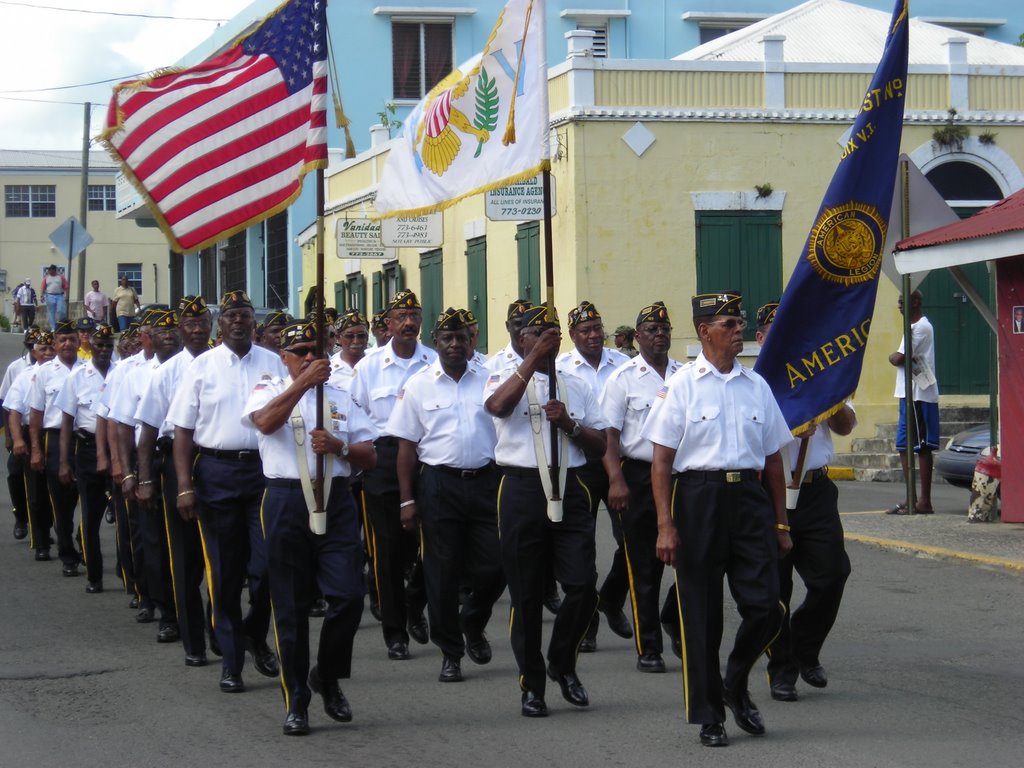
On Saturday, November 11, the U.S. Virgin Island celebrated Veteran’s Day with a parade through downtown Christiansted to the sea.

Representatives from all the branches of military present in the Virgin Islands marched along Company Street accompanied by members of the American Legion and Auxiliary, groups of scouts, ROTC from local schools and kids from the elementary school where the parade kicked off. The route wound through town to the grounds next to historic Fort Christian where a ceremony featuring distinguished speakers and the Cruzan Brass Band marked the occasion.

The Virgin Islands became a U.S. territory in 1917. During World War II islanders were exempt from the draft, but petitioned to join Americans in defending their country. Virgin Islanders have served in all major U.S. conflicts and currently have units stationed in Iraq.

A few years ago I met a native of Jamaica who immigrated to the United States and worked in public relations for a well-known luxury hotel. I questioned her about the island: where to stay other than an all-inclusive resort. You see, I’m a Europe through the Back Door type traveler not a tour group/all activities planned/chain hotel type traveler. I wanted to know if she had any suggestions on visiting the authentic Jamaica rather than the pre-packaged one.

She rolled her eyes dismissively. “You don’t want to see the real Jamaica,” she assured me. “It’s not paradise for the people who live there.”

While I haven’t encountered such a dark description of life in the Virgin Islands, locals stress that living here does not equate to a permanent vacation. The worries of the economy, jobs, education, affordable housing, gas prices (currently a low of $2.29/gallon) exist here. And on this Veteran’s Day they share the worry for the safe return of family members in Iraq. Perhaps next Veteran’s Day will find us a nation at peace.

Tuesday, October 31, 2006

Carambola beach


Flash floods subsided, sunshine returns. October and it is 85 degrees. For us, this seems a long, lingering summer. Weekend days spent, where else, the ocean.

St. Croix beaches are public, unlike St. Thomas, for example, which only has one public beach and all others require usage fees.

One beautiful beach sun seekers may visit is Carambola beach home to the Carambola beach resort. Named for the locally grown five-sided fruit, the carambola (or known state-side as star fruit), this stretch of beach lies on the sparsely populated northwest coast. At the end of a curvy, mountainside road Carambola beach forms a semicircular cove of quiet sand among the rocky cliffs. Bordered by lush tropical forests and mountains, Carambola beach creates the illusion of island isolation. (photo 1)

Bathers enter the beach on the far west end near the base of a mountain to avoid spiny urchins hiding amongst the reefs. Note the lack of fellow swimmers: discounted rates and reduced traffic are two bonuses to traveling during the off season. (photo 2)

Although maybe not the best place on island to snorkel, the beach chairs, hammocks, and beautifully manicured resort make a day at Carambola a perfectly lovely day at the beach. (That’s what Chuck says, anyway, photo 3)

While I cannot attest to the lodging at Carambola, I can confirm that the menu features a mighty tasty conch fritter with coconut sauce. Weekend nights feature sumptuous buffets with live entertainment. To find out more, visit Carambola Beach Resort.

Friday, October 27, 2006

Stranded Part 3--Goats on the Loose


No power this morning. The electricity ceased sometime early this morning before our alarm sounded at 6:30 p.m. The rains create swells to yesterday’s levels, so the main road was passable. Good thing, because I had to visit the Department of Revenue located mid-island to complete some business related to our move.

While taking our dog, Chuck, out for his morning walk, I learned from neighbors that the water was out now, too. A generator keeps the water pumps working once the current goes. The transmission in said generator burned up more than likely from overuse during the pass couple of days. “You can use water from the pool (located in the center of the condo complex) to flush,” a neighbor yelled.

About six hours later and after I’d decided a dip in the pool was all the bath I would get today, the power and water returned. I jumped in the shower and readied to visit the Department of Revenue. On the way the rains picked up and roadways filled. I made to the office, located behind the Sunny Isles shopping center (see yesterday’s post).

In the lobby a crowd was gathered opposite the door. A herd of brown and tan goats, wet and shaking, had gathered under the eaves of the Department of Revenue and huddled against the south facing glass wall.

From the upstairs waiting/cashier area, I could see the loading dock area of K-mart where a pond was beginning to form. One lone goat was attempting to cross the lawn toward the others.

I filed my paper work and hurried downstairs with the plan to call animal control about the wet and frightened goats. Once outside, the goats were no where to be found. With water rising and herds of goats disappearing, I decided I needed to get home quick.

Later that evening as the drizzle continued, I relayed the story of the goats to a St. Croix native. He explained that the shopping center and government offices had been pastureland before development, “in their defense, the goats were there first.”

Others navigating the storm: photo 1, man in golf cart is sideways on underwater service road, note flooded golf course behind him; photo 2, gekos usually stay at bug level on our back porch, this one scrambled to the ceiling to avoid water; photo 3, white heron thrilled that this maintenance compound is flooded creating a new feeding ground for him.